Grinding efficiency
Compare the time and energy needed to reach your required fineness, together with mill output.
Super Grind / Cement additives
Slow output, persistent pack set or an early-strength target? Super Grind helps limit particle re-agglomeration. Match the grade to your ball mill or VRM, then evaluate the result in your plant.
Without aid vs 0.1% Super Grind 553(H) in Razon’s trial. Review the full data and validate in your plant.

Match the constraint to a grade
Slow grinding can constrain output; pack set affects powder flow; strength and water demand influence the cement you can produce. Start with the issue you need to address, then use your mill type to narrow the Super Grind range.
Super Grind 370 targets grinding efficiency and powder flow in ball mills.
Super Grind 378 is the grinding-efficiency grade for VRM production.
Evaluate Super Grind 500 for early-strength development in ball mills.
Evaluate Super Grind 550 for early-strength development in VRM.
Super Grind 553 is positioned for normal consistency, fineness and strength.
A starting filter, based on Razon’s published range. Confirm the grade and dosage in your plant.
Share your mill, cement composition and the result you need.
Super Grind 553(H)
If strength is your constraint, review Razon’s PPC and PSC measurements at 1, 3, 7 and 28 days. These are results for 553(H), not a guarantee for every grade or plant. The full physical and chemical data remains available below each chart.
| Property | Unit | Without aid | 0.04% | 0.1% |
|---|---|---|---|---|
| Fineness | m²/kg | 359 | 362 | 360 |
| Normal consistency (N.C.) | % | 29 | 28 | 28 |
| Initial setting time (I.S.T.) | min | 230 | 235 | 230 |
| Final setting time (F.S.T.) | min | 310 | 300 | 310 |
| Compressive strength — 1 day | MPa | 11 | 13.5 | 19 |
| Compressive strength — 3 days | MPa | 22.5 | 26 | 30 |
| Compressive strength — 7 days | MPa | 33.5 | 37 | 44.5 |
| Compressive strength — 28 days | MPa | 48.5 | 55.5 | 60.5 |
| L.O.I. | % | 1.42 | 1.38 | 1.45 |
| SiO2 | % | 34.35 | 34.35 | 33.39 |
| Al2O3 | % | 12.74 | 12.83 | 12.78 |
| Fe2O3 | % | 4.35 | 4.32 | 4.25 |
| CaO | % | 42.45 | 42.3 | 43.27 |
| MgO | % | 0.99 | 1.26 | 0.9 |
| Mn | % | 0.08 | 0.08 | 0.08 |
| TiO2 | % | 0.78 | 0.77 | 0.76 |
| P2O5 | % | 0.27 | 0.26 | 0.31 |
| K2O | % | 0.52 | 0.53 | 0.52 |
| Na2O | % | 0.09 | 0.09 | 0.11 |
| SO3 | % | 1.43 | 1.43 | 1.96 |
| Sro — label as published | % | 1.83 | 1.83 | 0.03 |
| Cl | % | 0.01 | 0.01 | 0.01 |
| I.R. | % | 31.6 | 32.93 | 34.16 |
| Property | Unit | Without aid | 0.04% | 0.1% |
|---|---|---|---|---|
| Fineness | m²/kg | 360 | 362 | 365 |
| Normal consistency (N.C.) | % | 28 | 27.5 | 27.5 |
| Initial setting time (I.S.T.) | min | 190 | 190 | 195 |
| Final setting time (F.S.T.) | min | 290 | 290 | 285 |
| Compressive strength — 1 day | MPa | 10.5 | 13 | 16.5 |
| Compressive strength — 3 days | MPa | 20.5 | 22.5 | 25.5 |
| Compressive strength — 7 days | MPa | 36 | 38 | 44 |
| Compressive strength — 28 days | MPa | 51.4 | 56.7 | 63.5 |
| L.O.I. | % | 0.51 | 0.43 | 0.54 |
| SiO2 | % | 30 | 29.93 | 29.85 |
| Al2O3 | % | 10.28 | 10.26 | 10.2 |
| Fe2O3 | % | 3.16 | 3.12 | 3.21 |
| CaO | % | 46.79 | 46.77 | 46.84 |
| MgO | % | 5.43 | 5.52 | 5.47 |
| Mn | % | 0.04 | 0.04 | 0.04 |
| TiO2 | % | 0.61 | 0.61 | 0.61 |
| P2O5 | % | 0.06 | 0.07 | 0.06 |
| K2O | % | 0.59 | 0.6 | 0.6 |
| Na2O | % | 0.12 | 0.12 | 0.12 |
| SO3 | % | 2.31 | 2.34 | 2.32 |
| Sro — label as published | % | 0.07 | 0.07 | 0.08 |
| Cl | % | 0.01 | 0.01 | 0.01 |
| I.R. | % | 0.96 | 2.01 | 3.15 |
These trials use 553(H). The general 553 TDS recommends 0.10–0.30%; confirm the grade and trial dose with Razon.
Full data · CSVCompare the time and energy needed to reach your required fineness, together with mill output.
Assess free flow and the tendency of cement to form hard, packed masses in stacked bags.
Super Grind 553 is positioned for lower normal-consistency water demand in PPC and PSC cement.
Evaluate any proposed fly ash or GGBS increase against the required finished-cement performance.
Razon reports 25% higher strength at 24 hours and up to 40% at 28 days. These are manufacturer claims; establish results for your grade, materials and plant.
Use the published results to identify what to test with your own cement system.
Ball mills · VRM · PPC / PSC
Once you have identified the constraint, compare the grade for your mill and the performance you need. Super Grind covers grinding efficiency, early strength, and water demand in blended cement. Use the technical sheet to plan the starting dose.
| Grade | Application | Focus | Dosage | TDS |
|---|---|---|---|---|
| 370 — Super Grind | Ball mill | Pack set & efficiency | 0.03–0.08% | PDF: Super Grind 370 technical data sheet |
| 378 — Super Grind | Vertical roller mill | Pack set & efficiency | 0.03–0.08% | PDF: Super Grind 378 technical data sheet |
| 500 — Super Grind | Ball mill | Early strength | 0.02–0.07% | PDF: Super Grind 500 technical data sheet |
| 550 — Super Grind | Vertical roller mill | Early strength | 0.02–0.07% | PDF: Super Grind 550 technical data sheet |
| 553 — Super Grind | PPC / PSC cement | Water demand & strength | 0.10–0.30% | PDF: Super Grind 553 technical data sheet |
Dose by weight of clinker + additions. Confirm with a plant trial.
All five technical sheets reference ASTM C465. Shelf life: 6 months to one year in the original sealed container.
Particle separation, then validation
Grinding aids are liquid additives formulated with amines, glycols and other ingredients. They act on fragmenting clinker particles to limit the re-agglomeration that makes the mill grind the same material repeatedly.
The mill breaks clinker, gypsum and additions into finer particles. Razon describes typical clinker feed as pebbles up to about 20 mm.
The additive helps limit surface effects that cause the newly formed particles to bind again.
Compare fineness, output, power, flow and strength with a blank under your plant conditions.
Razon reports a 7–10% fineness improvement at a fixed processing time. Verify the result with your own materials and mill.
Razon technical support
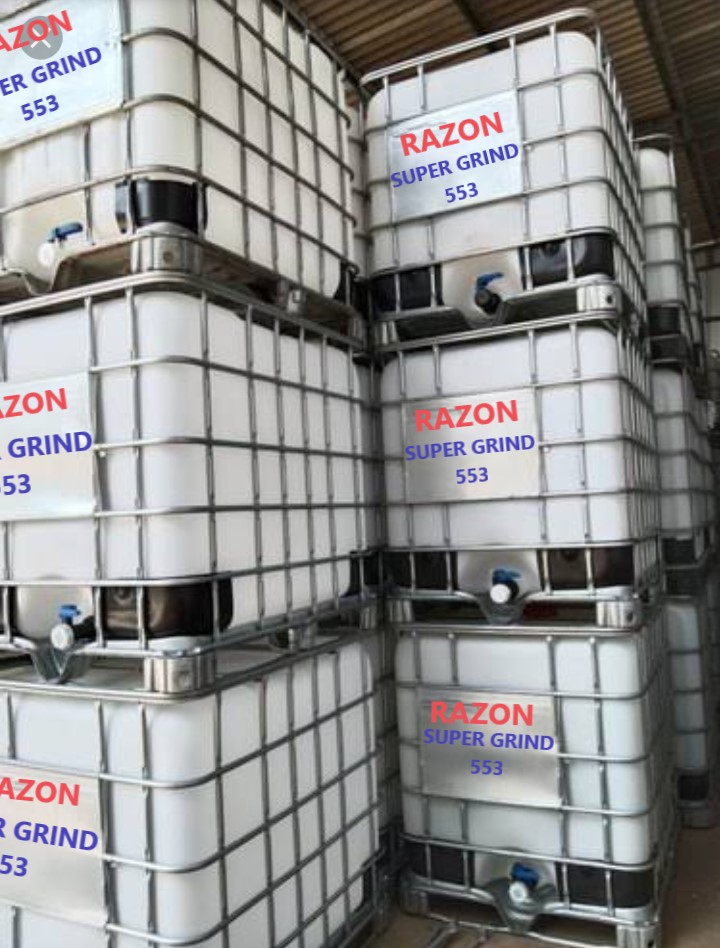
Razon’s technical team offers product discussions and at-plant demonstrations or appraisals. Share your mill type, cement composition and the performance constraint you want to improve.
Review the technical sheet and starting dosage, then run a controlled comparison with your current process.
Razon also invites enquiries for tailored additives and other grinding applications where processing bottlenecks limit production.
Discuss a sample and a controlled trial for your cement system.
Super Grind / plant trials
Use mill type and the main performance objective as the first filter: 370 for ball-mill grinding efficiency, 378 for VRM grinding efficiency, 500 for early strength in ball mills, 550 for early strength in VRM, and 553 for the published PPC or PSC performance focus. Confirm the final selection in a plant trial.
The five TDS files publish product-specific dosage ranges. Those ranges are trial guidance; establish the actual dose for the plant, cement composition and target performance.
No. They are Razon-published measurements for a specific trial set. The source material does not identify the complete independent test context, and the 553(H) identity and dose should be reconciled with the general 553 TDS before reuse.
Razon describes pack set as a loss of free-flow behaviour caused by interaction between cement powder particles, which can also appear as hard masses in stacked cement bags.
Yes. Razon's published page invites sample, commercial-quote and technical-support enquiries.
Tell us about your mill and the performance you want to improve. Razon can help with grade selection, samples and trial discussions.
Choose how you’d like to get in touch.
info@razonengg.com